Microsoft DP-600 Hot Questions - Braindumps DP-600 Pdf
Wiki Article
What's more, part of that TorrentVCE DP-600 dumps now are free: https://drive.google.com/open?id=1DK_aH-57Tux0yH1y_rmto5OMg2Nk3hZt
Our DP-600 training guide is not difficult for you. We have simplified all difficult knowledge. So you will enjoy learning our DP-600 study quiz. During your practice of our DP-600 exam materials, you will find that it is easy to make changes. In addition, our study materials will boost your confidence. You will be glad to witness your growth. Do not hesitate. Good opportunities will slip away if you stand still.
Microsoft DP-600 Exam Syllabus Topics:
| Topic | Details |
|---|---|
| Topic 1 |
|
| Topic 2 |
|
| Topic 3 |
|
>> Microsoft DP-600 Hot Questions <<
DP-600 Quiz Braindumps: Implementing Analytics Solutions Using Microsoft Fabric - DP-600 Quiz Torrent & DP-600 Exam Review
We have installed the most advanced operation system in our company which can assure you the fastest delivery speed on our DP-600 learning guide, you can get immediately our DP-600 training materials only within five to ten minutes after purchase after payment. At the same time, there is really no need for you to worry about your personal information if you choose to buy the DP-600 Exam Practice from our company.
Microsoft Implementing Analytics Solutions Using Microsoft Fabric Sample Questions (Q147-Q152):
NEW QUESTION # 147
You need to ensure the data loading activities in the AnalyticsPOC workspace are executed in the appropriate sequence. The solution must meet the technical requirements.
What should you do?
- A. Create a pipeline that has dependencies between activities and schedule the pipeline.
- B. Create and schedule a Spark job definition.
- C. Create a dataflow that has multiple steps and schedule the dataflow.
- D. Create and schedule a Spark notebook.
Answer: A
Explanation:
To meet the technical requirement that data loading activities must ensure the raw and cleansed data is updated completely before populating the dimensional model, you would need a mechanism that allows for ordered execution. A pipeline in Microsoft Fabric with dependencies set between activities can ensure that activities are executed in a specific sequence. Once set up, the pipeline can be scheduled to run at the required intervals (hourly or daily depending on the data source).
NEW QUESTION # 148
You have a data warehouse that contains a table named Stage. Customers. Stage-Customers contains all the customer record updates from a customer relationship management (CRM) system. There can be multiple updates per customer You need to write a T-SQL query that will return the customer ID, name, postal code, and the last updated time of the most recent row for each customer ID.
How should you complete the code? To answer, select the appropriate options in the answer area, NOTE Each correct selection is worth one point.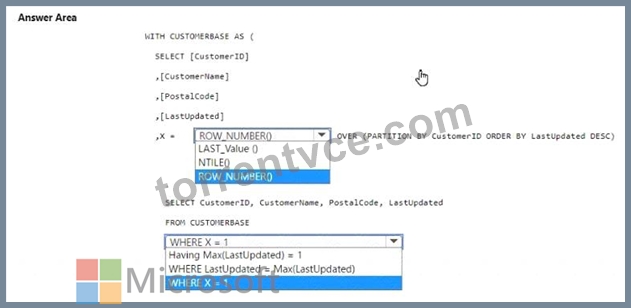
Answer:
Explanation: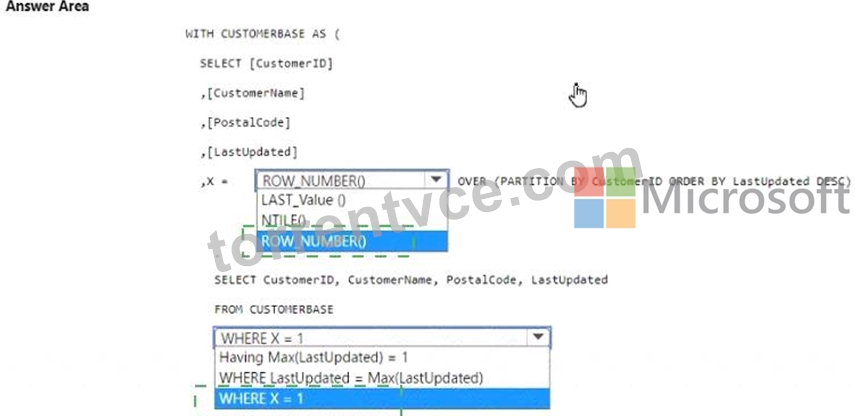
Explanation: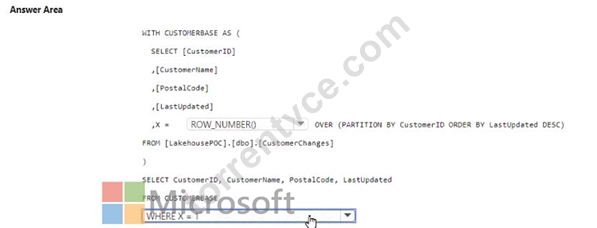
* In the ROW_NUMBER() function, choose OVER (PARTITION BY CustomerID ORDER BY LastUpdated DESC).
* In the WHERE clause, choose WHERE X = 1.
To select the most recent row for each customer ID, you use the ROW_NUMBER() window function partitioned by CustomerID and ordered by LastUpdated in descending order. This will assign a row number of 1 to the most recent update for each customer. By selecting rows where the row number (X) is 1, you get the latest update per customer.
References =
* Use the OVER clause to aggregate data per partition
* Use window functions
NEW QUESTION # 149
Case Study 2 - Litware, Inc
Overview
Litware, Inc. is a manufacturing company that has offices throughout North America. The analytics team at Litware contains data engineers, analytics engineers, data analysts, and data scientists.
Existing Environment
Fabric Environment
Litware has been using a Microsoft Power BI tenant for three years. Litware has NOT enabled any Fabric capacities and features.
Available Data
Litware has data that must be analyzed as shown in the following table.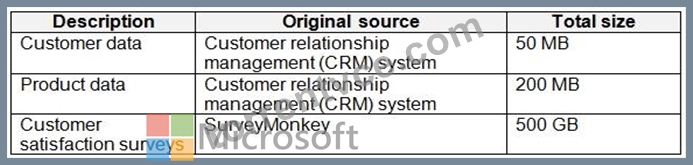
The Product data contains a single table and the following columns.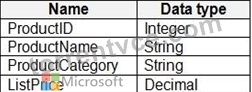
The customer satisfaction data contains the following tables:
- Survey
- Question
- Response
For each survey submitted, the following occurs:
- One row is added to the Survey table.
- One row is added to the Response table for each question in the survey.
- The Question table contains the text of each survey question. The third question in each survey response is an overall satisfaction score. Customers can submit a survey after each purchase.
User Problems
The analytics team has large volumes of data, some of which is semi-structured. The team wants to use Fabric to create a new data store.
Product data is often classified into three pricing groups: high, medium, and low. This logic is implemented in several databases and semantic models, but the logic does NOT always match across implementations.
Requirements
Planned Changes
Litware plans to enable Fabric features in the existing tenant. The analytics team will create a new data store as a proof of concept (PoC). The remaining Liware users will only get access to the Fabric features once the PoC is complete. The PoC will be completed by using a Fabric trial capacity The following three workspaces will be created:
- AnalyticsPOC: Will contain the data store, semantic models, reports pipelines, dataflow, and notebooks used to populate the data store
- DataEngPOC: Will contain all the pipelines, dataflows, and notebooks used to populate OneLake
- DataSciPOC: Will contain all the notebooks and reports created by the data scientists The following will be created in the AnalyticsPOC workspace:
- A data store (type to be decided)
- A custom semantic model
- A default semantic model
Interactive reports
The data engineers will create data pipelines to load data to OneLake either hourly or daily depending on the data source. The analytics engineers will create processes to ingest, transform, and load the data to the data store in the AnalyticsPOC workspace daily. Whenever possible, the data engineers will use low-code tools for data ingestion. The choice of which data cleansing and transformation tools to use will be at the data engineers' discretion.
All the semantic models and reports in the Analytics POC workspace will use the data store as the sole data source.
Technical Requirements
The data store must support the following:
- Read access by using T-SQL or Python
- Semi-structured and unstructured data
- Row-level security (RLS) for users executing T-SQL queries
Files loaded by the data engineers to OneLake will be stored in the Parquet format and will meet Delta Lake specifications.
Data will be loaded without transformation in one area of the AnalyticsPOC data store. The data will then be cleansed, merged, and transformed into a dimensional model The data load process must ensure that the raw and cleansed data is updated completely before populating the dimensional model The dimensional model must contain a date dimension. There is no existing data source for the date dimension. The Litware fiscal year matches the calendar year. The date dimension must always contain dates from 2010 through the end of the current year.
The product pricing group logic must be maintained by the analytics engineers in a single location. The pricing group data must be made available in the data store for T-SOL. queries and in the default semantic model. The following logic must be used:
- List prices that are less than or equal to 50 are in the low pricing group.
- List prices that are greater than 50 and less than or equal to 1,000 are in the medium pricing group.
- List prices that are greater than 1,000 are in the high pricing group.
Security Requirements
Only Fabric administrators and the analytics team must be able to see the Fabric items created as part of the PoC.
Litware identifies the following security requirements for the Fabric items in the AnalyticsPOC workspace:
- Fabric administrators will be the workspace administrators.
- The data engineers must be able to read from and write to the data store. No access must be granted to datasets or reports.
- The analytics engineers must be able to read from, write to, and create schemas in the data store. They also must be able to create and share semantic models with the data analysts and view and modify all reports in the workspace.
- The data scientists must be able to read from the data store, but not write to it. They will access the data by using a Spark notebook
- The data analysts must have read access to only the dimensional model objects in the data store. They also must have access to create Power BI reports by using the semantic models created by the analytics engineers.
- The date dimension must be available to all users of the data store.
- The principle of least privilege must be followed.
Both the default and custom semantic models must include only tables or views from the dimensional model in the data store. Litware already has the following Microsoft Entra security groups:
FabricAdmins: Fabric administrators
- AnalyticsTeam: All the members of the analytics team
- DataAnalysts: The data analysts on the analytics team
- DataScientists: The data scientists on the analytics team
- DataEngineers: The data engineers on the analytics team
- AnalyticsEngineers: The analytics engineers on the analytics team
Report Requirements
The data analysts must create a customer satisfaction report that meets the following requirements:
- Enables a user to select a product to filter customer survey responses to only those who have purchased that product.
- Displays the average overall satisfaction score of all the surveys submitted during the last 12 months up to a selected dat.
- Shows data as soon as the data is updated in the data store.
- Ensures that the report and the semantic model only contain data from the current and previous year.
- Ensures that the report respects any table-level security specified in the source data store.
- Minimizes the execution time of report queries.
Hotspot Question
You need to resolve the issue with the pricing group classification.
How should you complete the T-SQL statement? To answer, select the appropriate options in the answer area.
NOTE: Each correct selection is worth one point.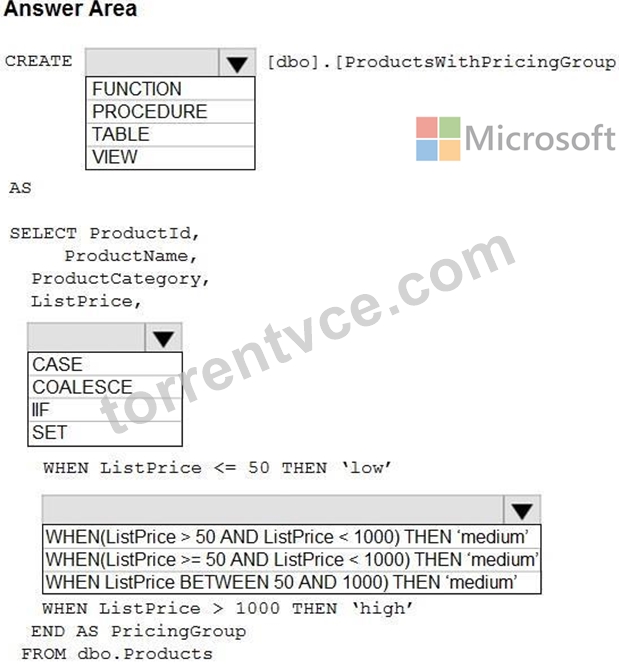
Answer:
Explanation: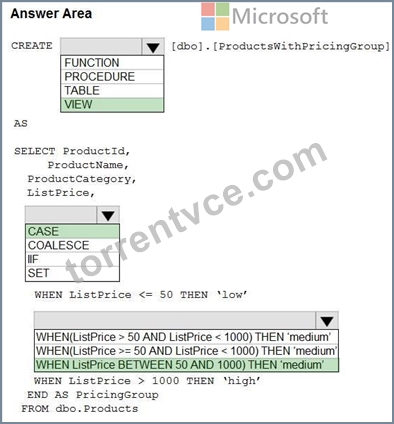
NEW QUESTION # 150
Your company has a finance department.
You have a Fabric tenant, an Azure Storage account named storage1, and a Microsoft Entra group named Group1. Group1 contains the users in the finance department.
You need to create a new workspace named Workspace1 in the tenant. The solution must meet the following requirements:
- Ensure that the finance department users can create and edit items in Workspace1.
- Ensure that Workspace1 can securely access storage1 to read and write data.
- Ensure that you are the only admin of Workspace1.
- Minimize administrative effort.
You create Workspace1.
Which two actions should you perform next? Each correct answer presents part of the solution.
NOTE: Each correct selection is worth one point.
- A. Assign the Contributor role to each finance department user.
- B. Create a workspace identity.
- C. Assign the Contributor role to Group1.
- D. Assign the Admin role to yourself.
Answer: B,C
NEW QUESTION # 151
You need to recommend which type of fabric capacity SKU meets the data analytics requirements for the Research division. What should you recommend?
- A. A
- B. P
- C. F
- D. EM
Answer: C
NEW QUESTION # 152
......
With years of experience in the field, TorrentVCE are always striving hard to provide customers with genuine Implementing Analytics Solutions Using Microsoft Fabric (DP-600) exam dumps so that they crack their Implementing Analytics Solutions Using Microsoft Fabric (DP-600) exam in less time. TorrentVCE also offer the best self-assessment software so besides memorizing DP-600 Exam Questions, applicants put their learning to the test and reduce their chances of failure in the real Implementing Analytics Solutions Using Microsoft Fabric (DP-600) examination.
Braindumps DP-600 Pdf: https://www.torrentvce.com/DP-600-valid-vce-collection.html
- Exam Questions for the Microsoft DP-600 - Improve Your Career Prospects ???? Search for ⏩ DP-600 ⏪ and download exam materials for free through ➡ www.pdfdumps.com ️⬅️ ????Latest DP-600 Test Vce
- Latest DP-600 Exam Price ???? DP-600 Online Lab Simulation ???? DP-600 Mock Exams ???? Open website ⮆ www.pdfvce.com ⮄ and search for ☀ DP-600 ️☀️ for free download ????DP-600 Book Pdf
- DP-600 Dump ???? DP-600 Reliable Exam Pdf ???? Free DP-600 Pdf Guide ???? Download ▷ DP-600 ◁ for free by simply searching on ➠ www.verifieddumps.com ???? ????DP-600 Dumps Questions
- Free PDF Microsoft - DP-600 –High-quality Hot Questions ???? Search for 《 DP-600 》 and easily obtain a free download on 「 www.pdfvce.com 」 ????DP-600 Detailed Study Dumps
- DP-600 Prep Training - DP-600 Study Guide - DP-600 Test Pdf ❕ Simply search for ➡ DP-600 ️⬅️ for free download on ( www.prepawaypdf.com ) ????DP-600 Updated Demo
- Authentic DP-600 Exam Questions ???? Latest DP-600 Test Vce ???? DP-600 Latest Exam Experience ???? Immediately open 【 www.pdfvce.com 】 and search for ⇛ DP-600 ⇚ to obtain a free download ????DP-600 Reliable Exam Syllabus
- 100% Pass High Hit-Rate Microsoft - DP-600 - Implementing Analytics Solutions Using Microsoft Fabric Hot Questions ???? Easily obtain free download of ➽ DP-600 ???? by searching on ☀ www.dumpsquestion.com ️☀️ ????DP-600 Mock Exams
- Test DP-600 Engine ???? Test DP-600 Engine ???? DP-600 Reliable Braindumps Files ???? Easily obtain ▛ DP-600 ▟ for free download through 【 www.pdfvce.com 】 ????Free DP-600 Pdf Guide
- 100% Pass High Hit-Rate Microsoft - DP-600 - Implementing Analytics Solutions Using Microsoft Fabric Hot Questions ???? Open website ➠ www.examcollectionpass.com ???? and search for ➤ DP-600 ⮘ for free download ????DP-600 Dump
- DP-600 Reliable Exam Pdf ???? DP-600 Updated Demo ???? Free DP-600 Pdf Guide ???? Easily obtain ➡ DP-600 ️⬅️ for free download through ➥ www.pdfvce.com ???? ????DP-600 Latest Exam Experience
- Exam Questions for the Microsoft DP-600 - Improve Your Career Prospects ???? Download ➡ DP-600 ️⬅️ for free by simply entering 「 www.troytecdumps.com 」 website ????DP-600 Updated Demo
- declanokec410919.losblogos.com, bookmarkstumble.com, thejillist.com, www.stes.tyc.edu.tw, www.stes.tyc.edu.tw, haimaatkh574519.gynoblog.com, antonetvj009711.blogdeazar.com, ezekielfftn749689.governor-wiki.com, asiyakznl345335.gynoblog.com, total-bookmark.com, Disposable vapes
DOWNLOAD the newest TorrentVCE DP-600 PDF dumps from Cloud Storage for free: https://drive.google.com/open?id=1DK_aH-57Tux0yH1y_rmto5OMg2Nk3hZt
Report this wiki page